expreg: Expand Region, Reborn
expand-region is one of my all time favorite Emacs packages. I’ve been using it since forever – press a key, the selection grows to the next semantic unit, press again, it grows further. Simple, useful, and satisfying. I’ve mentioned it quite a few times over the years, and it’s been a permanent fixture in my config for as long as I can remember.
But lately I’ve been wondering if there’s a better way. I’ve been playing with Neovim and Helix from time to time (heresy, I know), and both have structural selection baked in via tree-sitter – select a node, expand to its parent, and so on. Meanwhile, I’ve been building and using more tree-sitter major modes in Emacs (e.g. clojure-ts-mode and neocaml), and the contrast started to bother me. We have this rich AST sitting right there in the buffer, but expand-region doesn’t know about it.
The fundamental limitation is that expand-region relies on hand-written,
mode-specific expansion functions for each language. Someone has to write and
maintain er/mark-ruby-block, er/mark-python-statement, er/mark-html-tag,
and so on. Some languages have great support, others get generic fallbacks. And
when a new language comes along, you’re on your own until someone writes the
expansion functions for it.
Enter Tree-sitter
You can probably see where this is going. Tree-sitter gives us a complete AST for any language that has a grammar, and walking up the AST from a point is exactly what semantic region expansion needs to do. Instead of hand-written heuristics per language, you just ask tree-sitter: “what’s the parent node?”
Both Clojure and OCaml have rich, deeply nested syntax (s-expressions in Clojure, pattern matching and nested modules in OCaml), and semantic selection expansion is invaluable when navigating their code. Rolling my own tree-sitter based solution crossed my mind, but fortunately someone had already done it better.
expreg
expreg (short for “expand region”)1 is a package by Yuan Fu – the same person who implemented Emacs’s built-in tree-sitter support. Yuan Fu created expreg in mid-2023, shortly after the tree-sitter integration shipped in Emacs 29, and it landed on GNU ELPA soon after. It’s a natural extension of his tree-sitter work: if you’ve given Emacs a proper understanding of code structure, you might as well use it for selection too.
The package requires Emacs 29.1+ and the setup is minimal:
(use-package expreg
  :ensure t
  :bind (("C-=" . expreg-expand)
         ("C--" . expreg-contract)))
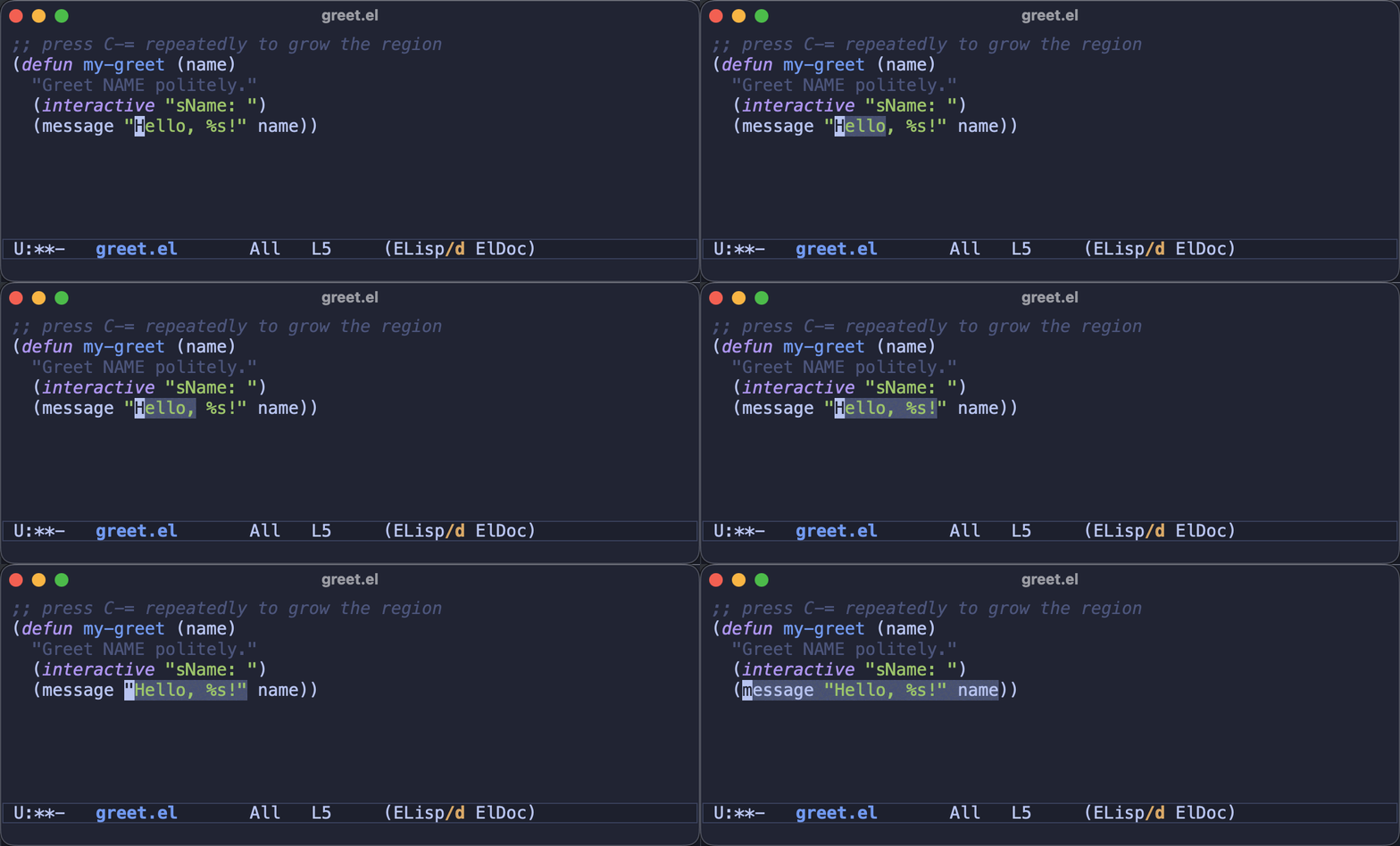
That’s it. Two commands: expreg-expand and expreg-contract. If you’ve used
expand-region, you already know the workflow. Here it is in action - each press
of C-= grows the selection to the next semantic unit:
What Makes It Better Than expand-region
It works with any tree-sitter grammar automatically. No per-language configuration. If your buffer has a tree-sitter parser active, expreg walks the AST to generate expansion candidates. OCaml, Clojure, Rust, Go, Python, C – all covered with zero language-specific code.
It works without tree-sitter too. This is the key insight that makes expreg a
true expand-region replacement rather than just a tree-sitter toy. When no
tree-sitter parser is available, it falls back to Emacs’s built-in syntax tables
for words, lists, strings, comments, and defuns. So it works in
fundamental-mode, text-mode, config files, commit messages – everywhere.
It generates all candidate regions upfront. On the first call to
expreg-expand, every expander function runs and produces a list of candidate
regions. These are filtered, sorted by size, and deduplicated. Subsequent calls
just pop the next region off the stack. This makes the behavior predictable and
easy to debug – no more wondering why expand-region jumped to something
unexpected.
It’s tiny. The entire package is a single file of a few hundred lines. Compare that to expand-region’s dozens of mode-specific files. Less code means fewer bugs and easier maintenance.
Customization
The expander functions are controlled by expreg-functions:
(expreg--subword    ; CamelCase subwords (when subword-mode is active)
 expreg--word       ; words and symbols
 expreg--list       ; parenthesized expressions
 expreg--string     ; string literals
 expreg--treesit    ; tree-sitter nodes
 expreg--comment    ; comments
 expreg--paragraph-defun) ; paragraphs and function definitions
There’s also expreg--sentence available but not enabled by default – useful
for prose:
(add-hook 'text-mode-hook
          (lambda ()
            (add-to-list 'expreg-functions #'expreg--sentence)))
Should You Switch?
If you’re using tree-sitter based major modes (and in 2026, you probably should
be), expreg gives you better, language-aware expansion for free. If you’re still
on classic major modes, it’s at least as good as expand-region thanks to the
syntax-table fallbacks.
The only reason to stick with expand-region is if you rely on some very specific mode-specific expansion behavior that expand-region’s hand-written functions handle and expreg’s generic approach doesn’t. In practice, I haven’t hit such a case.
I’ve been using expreg for a while now across Clojure, OCaml, Emacs Lisp, and various non-programming buffers. It just works. It’s one of those small packages that quietly improves your daily editing without demanding attention. And like tree-sitter powered code completion, it’s another example of how tree-sitter is reshaping what Emacs packages can do with minimal effort.
That’s all I have for you today. Keep hacking!
-
Naming is hard. ↩